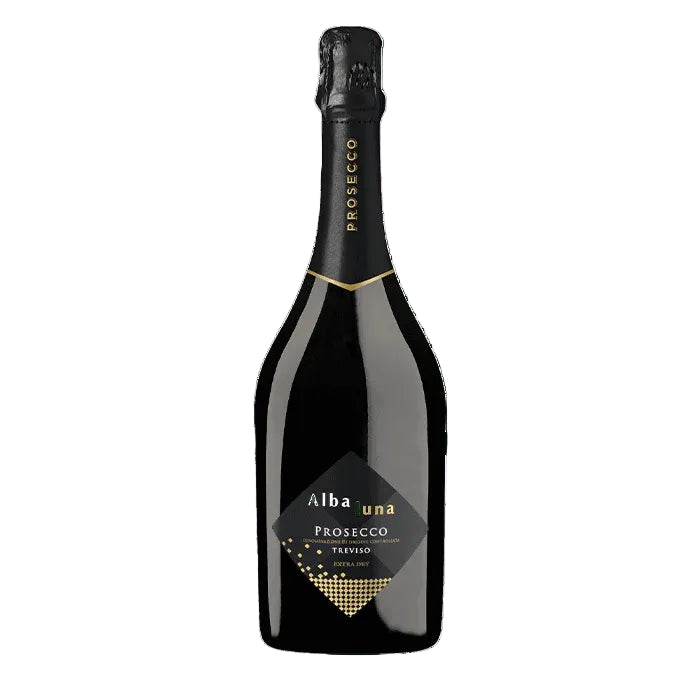
PROSECCO DOC EXTRA DRY WHITE ALBA LUNA VENETO
PROSECCO DOC EXTRA DRY WHITE ALBA LUNA VENETO
Couldn't load pickup availability
Tasting notes: this Alba Luna Extra Dry Prosecco DOC (12 to 17 g/L of residual sugar in the bottle) is a Prosecco that presents a straw-yellow colour with slight greenish reflections. It is an intense, pleasant, balanced wine, with fruity notes and an elegant and persistent finish. It is ideal as an aperitif and pairs elegantly with light risottos and white meats.
It should be served between 6°C and 8°C.
Origin: Treviso, Veneto region
Grape varieties: 100% Glera (Prosecco)
Alcohol content: 11%
Prosecco
Prosecco can only be produced in northeastern Italy, specifically in the Veneto and Friuli-Venezia Giulia regions. The main grape variety used in winemaking is Glera, present in a percentage of no less than 85%. The remaining 15% can come from 4 indigenous grape varieties, Verdiso, Bianchetta Trevigiana, Perera, and Glera lunga, and from 4 international varieties, Pinot Bianco, Pinot Grigio, Pinot Nero, and Chardonnay.
Depending on the production process, Prosecco can be Tranquillo (still), Frizzante (semi-sparkling), and Spumante (sparkling). The latter version is the most widespread, representing about 90% of all Prosecco production. The pressure in the bottle must be more than 3 times the normal atmospheric pressure at sea level, favouring a persistent and creamy bubble. At the end of the first fermentation, the wine undergoes a second fermentation, given by the addition of selected yeasts and sugar, which allows the formation of carbon dioxide and slightly increases the alcohol content. The second fermentation occurs in most cases in an autoclave (pressurised stainless steel tank), following the Martinotti or Charmat method. At the end of the second fermentation in the autoclave, the wine is filtered and bottled at controlled temperature and pressure. This technologically advanced process allows for the creation of clean, fresh, and fruity wines. The second fermentation can occur in the bottle, following the traditional Sui Lieviti method or the Clássico method, also known as Champenoise. In the first case, turbidity may occur due to the deposit of yeasts at the bottom of the bottle, while in the second case, the yeasts are removed with the classic technique of Sboccatura or dégorgement.
Partilhar