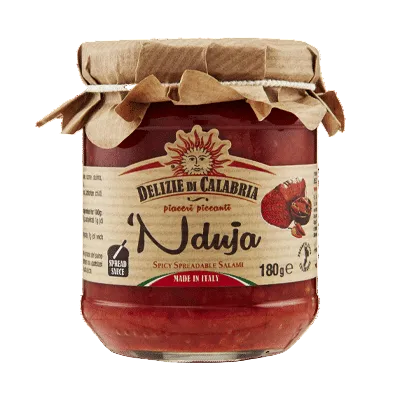
'NDUJA WITH OLIVE OIL
'NDUJA WITH OLIVE OIL
Couldn't load pickup availability
’Nduja
'Nduja is a true artisanal product of excellence. It cannot be produced at any time of the year. To possess all its organoleptic characteristics and the correct consistency, it must be produced in the winter months, the coldest, when pork is traditionally processed. From the animal, lardello, guanciale, and pancetta are used. Salt and plenty of spicy Calabrian peperoncino are added. It contains no preservatives, thanks to the amount of spicy chili, which has antiseptic properties. Another characteristic that makes this sausage unique is its creamy consistency, allowing it to be spread.
'Nduja originated in Spilinga, a small municipality in the province of Vibo Valentia. In recent decades, many Calabrian variations of this sausage have appeared, but Spilinga holds the paternity of the original recipe and the title of "City of 'Nduja", hosting one of the region's most important festivals there since 1975, on August 8th.
Ingredients: ’Nduja 90% (pork fat, pork, chili, salt), vegetable oils (sunflower seed oil, extra virgin olive oil).
How to use
Thanks to its creamy consistency, 'Nduja is perfect to be enjoyed as an appetizer or a starter, on a bruschetta, for example, in pizzas and pinsas, or to season pasta dishes. It is recommended to combine it with paccheri, which are capable of magnificently retaining the seasoning, or with scialatielli. The calibre of this pasta ensures a perfect harmony between the flavour of durum wheat and the spiciness of 'Nduja. Some traditional Calabrian recipes suggest other uses for 'Nduja: with roasted zucchini flowers, in 'Nduja and Caciocavallo Silano timbale, or in eggplant and 'Nduja meatballs, which are combined with tuna and aromatic herbs. Another Calabrian specialty is bean soup with 'Nduja. Despite its simplicity, it is a true monument to regional culinary tradition.
Calabrian Peperoncino
The generic name Calabrian Peperoncino covers all the varieties cultivated exclusively in Calabria belonging to the species Capsicum annuum L., the spicy fruit of a plant belonging to the Solanaceae family, native to Central and South America. Known and widely consumed in Mexico for 9,000 years, it arrived in Europe aboard Christopher Columbus's three caravels when he returned from his voyage to America in 1492. Thanks to its strong flavour and vigorous aromatic character, it quickly spread in Spain and the Mediterranean basin.
It is the only chili capable of providing an exceptional spicy flavour without burning the taste buds. The peperoncino from this region is of excellent quality; its growth is favoured by optimal humidity levels, and it does not need to be chemically treated. The chilies must be naturally dehydrated, and the most renowned ones are produced in the Monte Poro area. The Calabrian people use it as a condiment in pasta, pizzas, vegetables, or meat dishes.
Delizie di Calabria
The story of Delizie di Calabria, a family business founded by Domenico Scalise, began four decades ago in the region where the sun shines 300 days a year: Calabria. An important city of ancient Magna Graecia, this very mountainous region of southern Italy lies between the Ionian Sea (to the east) and the Tyrrhenian Sea (to the west) and is separated from Sicily by the Strait of Messina. Here, peperoncino found its ideal habitat, becoming the exponent of a rich and healthy gastronomic culture.
The history of the Calabrian tradition of preserves is so old that it is lost in time. Products of the land were preserved in jars and remained available all year round, with all their freshness. Born as a small farm dedicated to processing agricultural products, Delizie di Calabria is now a reference in the production of Calabrian Peperoncino and other Calabrian riches. A modern and efficient production structure, but respectful of the environment. It combines peperoncino with other tasty ingredients, such as Tropea red onion, olives, dried tomatoes, bergamot, among many others. Each ingredient finds space on tables, but also in pantries, full of delicious preserves.
Partilhar